
The Foundress, and a hundred and fifty years
Every custom at St Elowen’s comes, in the end, from one small light on one dark night. Here is how.
The maiden of the storm
St Elowen was a maiden of old Cornwall who kept a lantern burning through a night of storm to guide the fishing boats safely home.
That is the whole story. It is not a large story, and it does not need to be. Everything the school has, it has from her: its name, and the seven-pointed star on its crest, and the silver star hidden in the pudding, and the lantern in the tower, and the lanterns of the parade, and the words carved over the door. A light kept for someone you cannot see, on the chance that they are out there, and lost, and coming home. That is the whole of St Elowen’s, and it began with her.
Honoria Elowen
A hundred and fifty years ago, a woman named Honoria Elowen bought a rambling old house in the Weald of Kent and made it into a school for girls. She was not a young woman when she did it, and she had carried the idea of a school inside her for a long time, the way some people carry a tune.
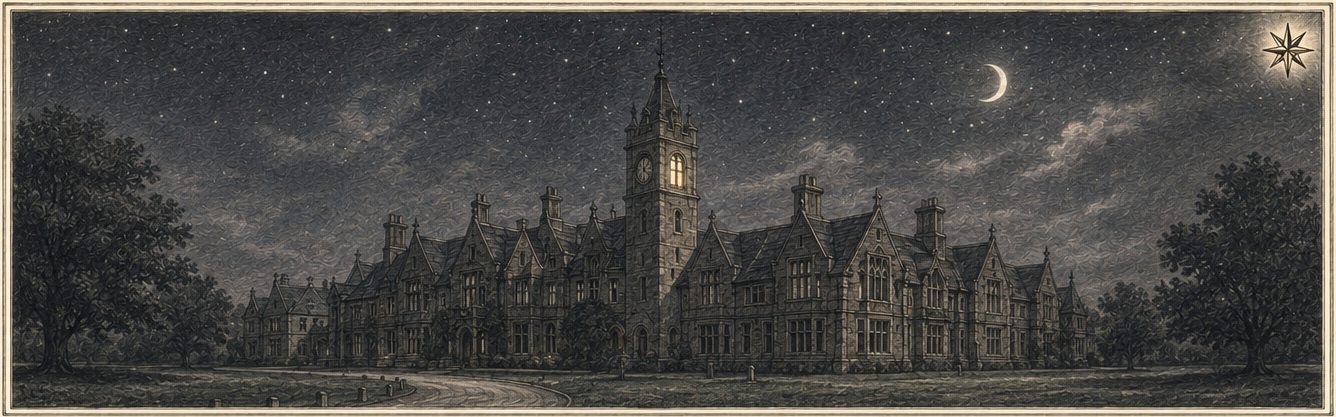
She had been a girl away at school herself, once, a long way from home, and she never forgot what the first night in a strange bed felt like. One day she built the school she had needed then, on a hill, at the end of a drive, with a tower she could see from every field on the estate.
And in the window of that tower she kept a lantern burning, every night of her life, so that no homesick girl, waking in the dark in a strange new bed, need ever believe herself the only soul awake in the world. If she looked from her dormitory window, there was the light. Someone was up. Someone had thought of her. She was not alone.
And then?
And then she grew old, as everybody does, and one day she was not able to climb the stair any more, and one day after that she was not there at all.
The light did not go out.
It has not gone out since. Not in a gale, not in a war, not on the night the electricity failed and the whole of the Weald lay black from here to the sea. Somebody has climbed that stair every single night for a hundred and fifty years, and lit it, and come down again, and said nothing.
The school does not know who. The school has never known who. The door at the foot of the stair is locked, and the school, in the way of schools, long ago decided that some things are simply so, and stopped asking.
Emily Ashworth did not stop asking.
Lumen servamus. We keep the light.Carved over the door, and true for a hundred and fifty years before anybody thought to translate it.
There is another school, on the far side of the water, with a light of its own, and no reason on earth to know about ours.